Bargate Rovers, and a Central Midlands League that just moved under everyone
At the end of July the Central Midlands League confirmed it was rebuilding a chunk of its middle. Four Division One sections became three. Division Two came down to ten clubs and picked up a new sponsor. Clubs left, clubs arrived, and one club came back from the dead. If you're at a club in that league, your fixture list this season has names on it you haven't played in years — and that has a boring, expensive consequence most committees don't spot until August.
Bargate Rovers
Bargate Rovers have been going since 1957. That's sixty-nine years of a Derbyshire club turning out, which in grassroots terms is close to geological. Clubs at this level fold constantly — a treasurer moves away, a pitch gets sold, two committee members fall out over a WhatsApp group. Surviving seven decades is the achievement, and it's why the crest carries the date.
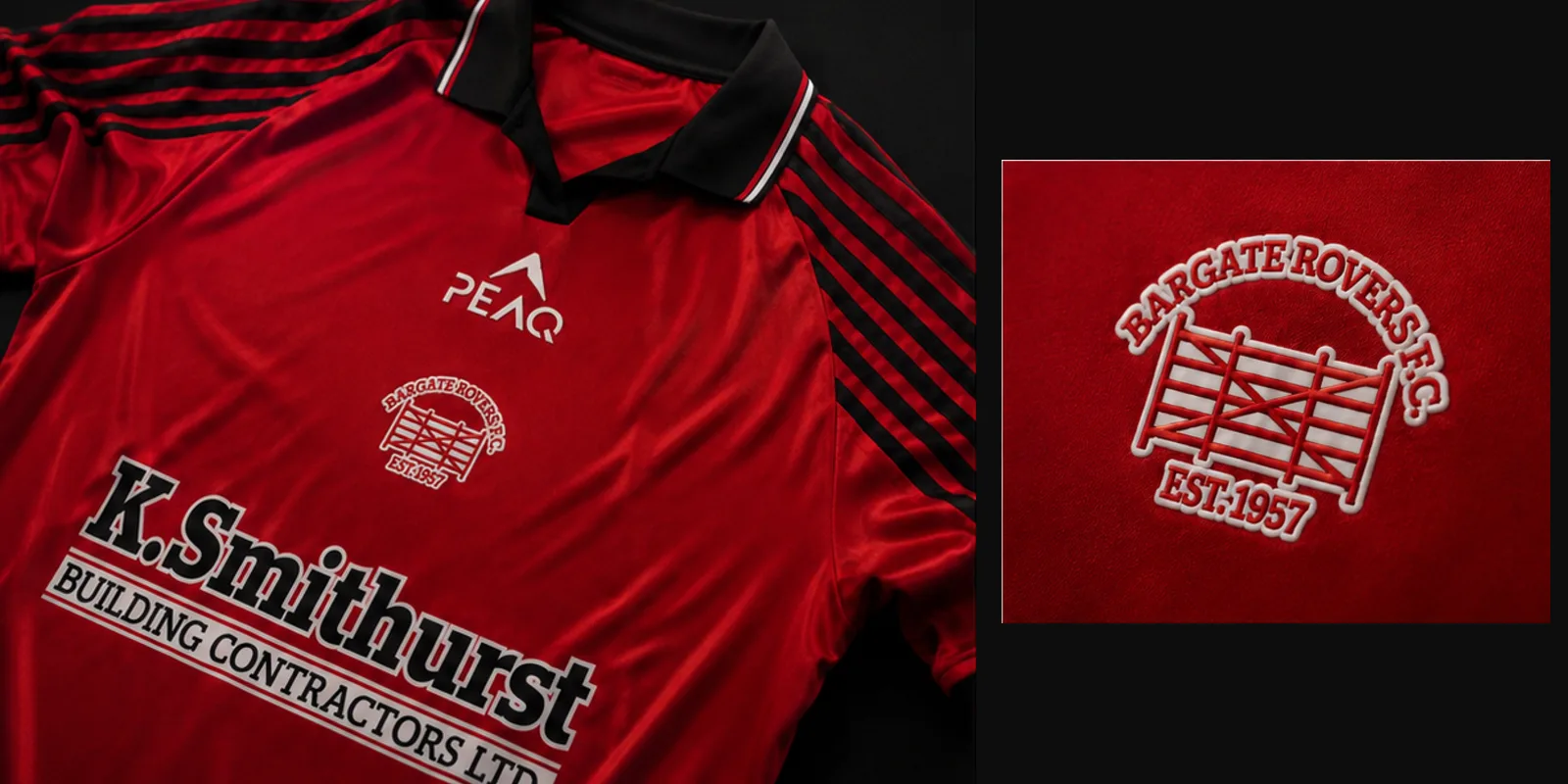
The crest itself is a five-bar gate, which is the kind of quiet joke a club only gets away with if it's had seventy years to settle in. On the shirt at the top of this page it's rendered as a silicone badge — raised off the fabric rather than printed into it, so it catches the light and you can feel the edge of it with a thumb. Red and black, black polo collar with red and white tipping, black stripes down the sleeve, and K. Smithurst Building Contractors across the chest. A local builder on a local shirt, which is how nearly all of this gets paid for.
They sit inside the Central Midlands set-up, which is the league that stitches together grassroots football across Derbyshire, Nottinghamshire, south Yorkshire and into Lincolnshire. It is one of the larger non-league pyramids in this part of the country and it feeds a serious number of clubs.
What actually changed for 2026
The restructure was announced at the end of July, and the shape of it is this:
- Division One went from four sections to three. North now runs to 14 teams, Central to 13 and South to 14, built out of the old West and East divisions plus development and reserve sides.
- Division Two came down to ten clubs, with a new sponsor in RPH Group of Huthwaite. Ripley Town Reserves came in — which is a two-minute drive from our studio in Codnor.
- Clubs moved both ways. Burton United have been revived and are back in. Division Two lost Ashland Rovers Reserves to the Notts Senior League and Winster Darley Lions to the Hope Valley League, and lost Markeaton the good way, by promotion.
The league's stated reasoning was to get a reasonable number of matches for everyone, which is the right problem to solve. Half-empty divisions produce blank Saturdays, and blank Saturdays lose you players.
Why a reshuffle is a kit problem
Here's the bit that catches clubs out. A new division isn't just new opposition — it's a new set of shirt colours you have to not clash with, and nobody audits that until a referee does it for them twenty minutes before kick-off.
The rule is simple and it is enforced: if the referee decides the two teams are too similar, the away side changes. If the away side can't change, you have a problem that ranges from a delayed kick-off to a squad playing in bibs in a photo that lives on the internet forever.
In a settled division you know your fixture list and you've long since discovered which two clubs you need a change shirt for. Move to a new section with seven clubs you've never played and that knowledge is gone. This year, a lot of Central Midlands clubs are in exactly that position.
The twenty-minute job worth doing now
Get your new division's fixture list. Go through it and write down the home shirt colour of every club on it. It takes twenty minutes and a bit of scrolling through club social media.
You're looking for two things. The obvious clashes, and the sneakier ones your change kit doesn't actually solve. Plenty of clubs run a white change shirt and then discover the two sides they most needed it against also play in white. Dark against light isn't enough on its own — you want genuine contrast against the specific shirts you'll be stood opposite.
Red clubs have the most checking to do here, and Bargate are a red club. Red is common enough at this level that if you're moving into an unfamiliar division you should plan on meeting one or two other red sides rather than hope you won't. If that's you, the change shirt isn't a nice-to-have you get round to in October. It's the fixture list telling you what to order.
If the audit says you're covered, you've spent twenty minutes for peace of mind. If it says you aren't, you've found out in July rather than on a Saturday in September, and July is a much cheaper month to find out in.
Working back from the first fixture
Custom kit runs about four to five weeks from artwork sign-off, and the full run from first conversation to delivery is usually six to eight. That number is the ceiling rather than the average, but you should plan against the ceiling, because the one thing you cannot buy at any price is time.
Work backwards from your opener. If you're kicking off in early September and you want kit in hands a week before, artwork needs signing off around the third week of July. If you're reading this having already missed that, the answer isn't to panic-order the whole thing — it's to sort the change shirt first, which is the item a fixture list can force on you, and do the full kit properly for the second half of the season. Our pre-season kit timeline lays the whole run out week by week.
If your club just moved division
Reshuffles are the moment clubs reappraise kit, and not only because of clashes. A new division means new opposition seeing you for the first time, and a fair few clubs decide that's the season to stop wearing something they inherited three committees ago.
If that's you, the two useful reads are our price guide for the real numbers, and the supplier guide for the questions worth asking before you commit. We're in Codnor, so most Central Midlands clubs are a short drive away — there's a Derby and Derbyshire page with the local detail. Put your squad through the configurator for a per-player figure to take to the committee.