When the size chart runs out: XL football kit and S.C. Wanderers
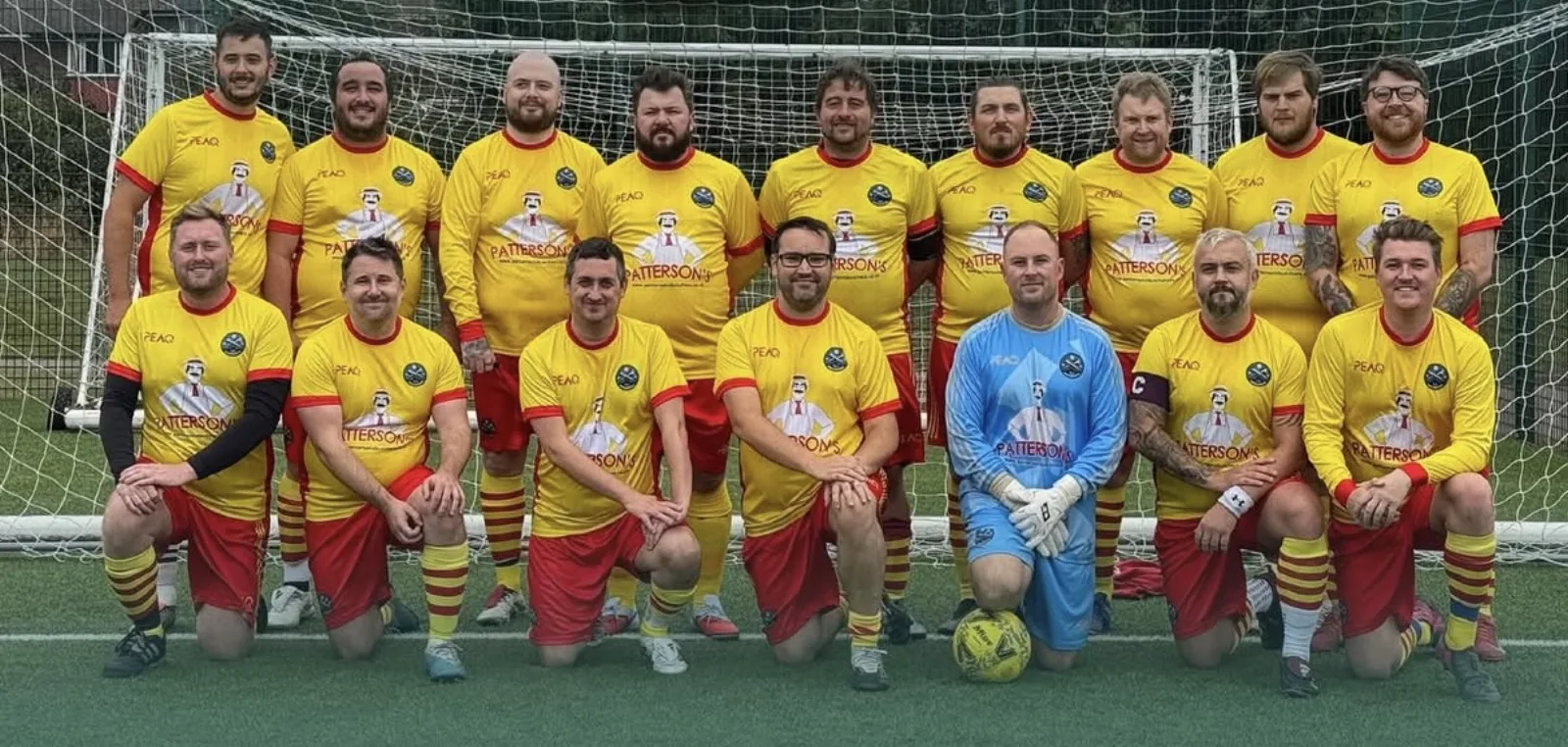
Every kit conversation eventually reaches the size chart. For most clubs it's a footnote — one lad needs a 2XL, everyone else sorts themselves out. For an XL club it's the entire conversation, because the shelf they're being sold from ran out three sizes ago. S.C. Wanderers play in a league where that is true of the whole squad, and it changes what a kit supplier actually has to do.
Who S.C. Wanderers are
Sheffield, formed in 2022. Their own description is the tidiest one available: an inclusive football club playing in the Yorkshire XL11s, with a big focus on physical and mental well-being. The crest is two crossed steel girders under a white rose — Steel City, Yorkshire, no further explanation required.
They are not a novelty side. There's a full 25/26 fixture list, a squad of nearly thirty, a captain, a man of the match sponsor and three shirt sponsors. They run their own wellbeing arm, S.C. Wellbeing, started in 2024. The football is the front door; the rest of it is the point.
What XL football actually is
XL football is 11-a-side football organised around larger players. The Yorkshire XL11s bills itself as the home of XL football and runs a Premiership and a Championship across roughly thirty teams. Scan the Wanderers' fixture list and you'll see who they're up against: Wakefield Wideboys, EyUp Bradford, Durham XL 11's, Cleveland Erimus, and a run of MvF sides — Nottinghamshire, Lincoln, Hull.
MvF is MAN v FAT Football, which has been running since 2014 and now fields well over a hundred teams across England, Scotland and Wales. You need a BMI of 27.5 or over to play, and the league table rewards weight lost as well as goals scored. It is competitive football with a second scoreboard running alongside it.
Add it up and there are a few hundred clubs in this country whose entire squad sits outside the size range that ordinary teamwear is built for. That is a lot of teams with the same unglamorous problem.
Where catalogue kit gives up
Most off-the-peg teamwear ranges stop at 2XL, sometimes 3XL if you're lucky with the manufacturer. Our own retail range stops at 3XL, so this isn't a competitor dig — it's how stock ranges work. You hold finished garments in a warehouse, so you hold the sizes that sell in volume, and the tail gets cut.
For an XL club that produces one of two outcomes, and both of them are bad. Either the order can't be filled at all, or it gets filled to the ceiling and three or four players are handed the biggest thing available and told to make it work. A shirt that's technically the right size and practically the wrong shape is not a fit. It's a compromise with a label in it.
The workaround clubs land on is worse still: buy the squad's kit from the range, and buy the lads at the top end something plain that vaguely matches. Now you've got a team photo where four players are visibly not in the kit.
Nobody gets a different shirt
This is the actual argument for sublimation on an XL squad, and it's got nothing to do with fabric weight or wash durability.
A sublimated shirt isn't picked off a rack and decorated. The artwork is printed into the panels and the garment is cut and made per order, per size. A 4XL is produced from the same design file as a medium, laid out to that size's pattern. The stripes land where stripes should land. The sponsor sits in the middle of the chest rather than halfway round a ribcage. The badge is the same badge.
Look at the Wanderers' team photo at the top of this piece. Sixteen players, one kit. You cannot tell from the shirts who is at which end of the size chart, which is precisely the outcome you want and precisely what a stock range cannot give you.
How big is big enough?
Our adult chart runs to 4XL as standard. In real measurements, rather than letters:
- 4XL shirt — 54in full chest, 33in body length.
- 3XL shirt — 52in full chest, 33in body length.
- 2XL shirt — 49in full chest, 32in body length.
- 4XL shorts — 36in relaxed waist, stretching to 56in.
Because every garment is made to order rather than pulled from stock, 4XL isn't a hard wall either. If someone in your squad needs to go beyond it, ask — it's a pattern change, not a stock problem. That sentence is impossible for a catalogue supplier to write, and it's the whole difference.
Worth saying plainly: ordering a 4XL costs the same as ordering a medium. There is no big-size surcharge, and any supplier that quotes you one is telling you they're buying stock and reselling it.
Sizing a squad you can't guess
The one thing XL clubs must not do is size the squad by eye, and the temptation is stronger here because the guesses feel more obvious. They aren't. Someone who wears a 3XL t-shirt is not automatically a 3XL in a match shirt, and the gap between our 3XL and 4XL is two inches of chest — narrow enough to get wrong and wide enough to matter.
Measure against the chart, and measure the chest over whatever the player will actually train in. If a club is running weekly weigh-ins, as MAN v FAT sides do, there's a second question worth asking out loud: order for the body in the room now, or the body they're working towards? Order for now. A shirt that fits today gets worn every week; a shirt bought for a target size sits in a bag. Squads on that journey tend to reorder anyway, and we keep your artwork on file so a top-up is a five-minute job.
The full method is in our guide to sizing a football kit for a whole squad, and it applies here unchanged — it just matters more.
What it costs
A full sublimated kit — shirt, shorts and socks, names and numbers included — is £30 a player. A 24-player squad like the Wanderers' is £720, and it's £720 whether the squad averages a medium or a 3XL. Add silicone badges if you want the crest to stand off the shirt.
If the number needs finding rather than paying, the same four routes apply to an XL club as anyone else, and sponsors are usually the answer — see who actually pays for a grassroots kit. The Wanderers carry three sponsors on that shirt. Local businesses are noticeably willing to back a club that's visibly doing some good, and an XL side has a much better story to sell than a Sunday league team with a decent left back.
If you run an XL side
You already know the size chart is the first question, so ask it first. Get the top end of the range in writing before you talk about colours, find out whether the garments are made to order or pulled from stock, and ask what happens if one player needs to go past the chart.
The answers sort the suppliers out quickly. We're a Derbyshire studio, an hour down the road from Sheffield — there's a Sheffield page with the local detail, or you can put your squad through the configurator and get a per-player number without speaking to anyone.